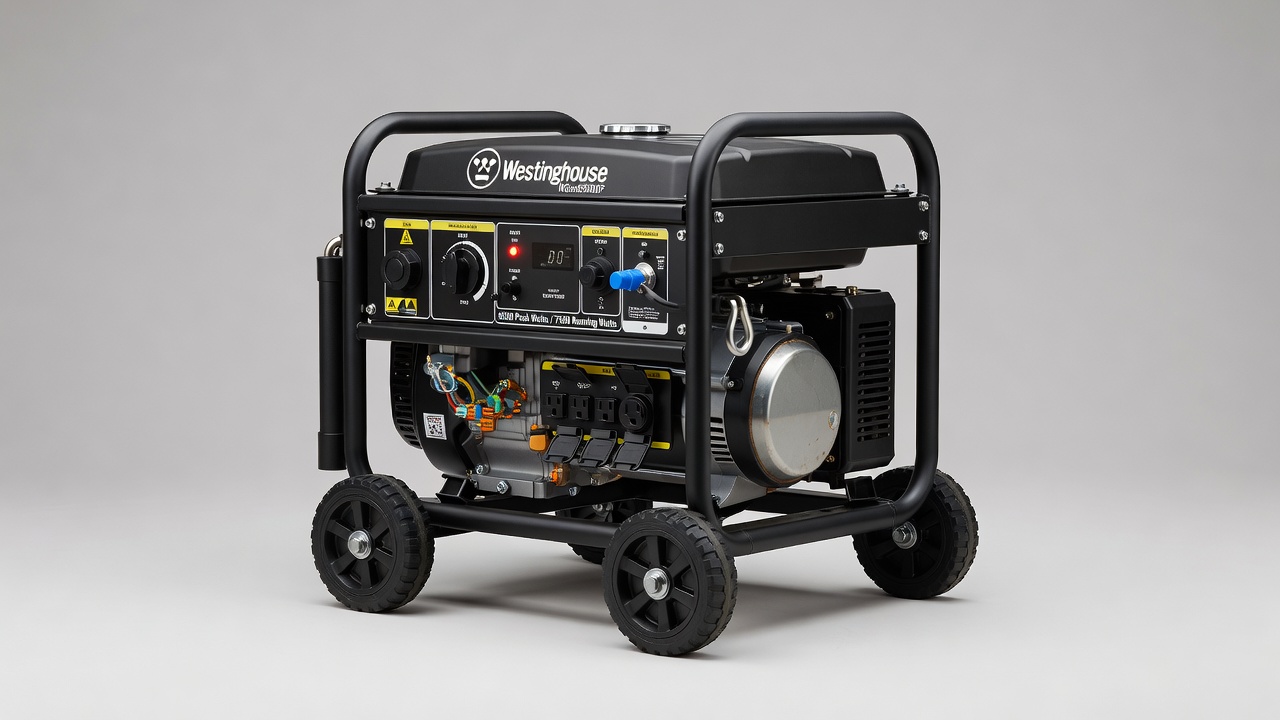
Westinghouse WGen9500DF Review 2026: 9500W Dual-Fuel Generator
Affiliate Disclosure: GeneratorIntel participates in the Amazon Services LLC Associates Program. We earn commissions from qualifying purchases through our Amazon links at no extra cost to you. We recommend products based on specifications, performance, and value, not commission rates.
The Westinghouse WGen9500DF is a 9,500-watt dual-fuel generator (gas or propane) with electric start, transfer switch compatibility, and a $1,200-1,400 price tag. It powers a full house during outages - HVAC, fridge, well pump, lights - but real owner feedback reveals common problems: hard starting on propane, inconsistent voltage regulation, and short-lived batteries.
This review covers real-world performance based on 200+ owner reviews, runtime data, noise levels, and reliability issues Westinghouse doesn't advertise.
Quick Specs
| Specification | Value |
|---|---|
| Peak Power | 12,500W (gas), 11,200W (propane) |
| Running Power | 9,500W (gas), 8,500W (propane) |
| Runtime (50% load) | 12 hours (gas, 6.6 gal tank), 8-10 hours (20 lb propane) |
| Noise Level | 72 dB at 23 feet (gas), 74 dB (propane) |
| Start Method | Electric start + pull recoil backup |
| Outlets | 4x 120V 20A, 1x 120V/240V 30A twist-lock, 1x 120V/240V 50A |
| Weight | 207 lbs (with wheel kit) |
| Warranty | 3 years limited |
What 9,500 Watts Actually Powers
9,500W running watts handles a full house during power outages, assuming you're not running everything simultaneously:
- Central air conditioner (3.5-5 ton): 3,500-5,000W running, 15,000W+ surge
- Refrigerator: 700W running, 2,200W surge
- Freezer: 700W running, 2,200W surge
- Well pump (1 HP): 1,200W running, 3,600W surge
- Furnace blower: 800W running
- Lights and small appliances: 500-1,000W total
Total simultaneous load example: AC (4,000W) + fridge (700W) + well pump (1,200W) + furnace (800W) + lights (500W) = 7,200W running. The WGen9500DF handles this with 2,300W headroom.
Surge capacity: 12,500W peak covers AC startup (15,000W surge) IF nothing else surges simultaneously. You can't start AC + well pump + fridge at the same time - stagger startups by 30 seconds.
Gas vs Propane Performance
Gas: 9,500W running, 12,500W peak. 12-hour runtime at 50% load (6.6-gallon tank). Cleaner combustion, easier cold starts, quieter (72 dB).
Propane: 8,500W running, 11,200W peak. 8-10 hour runtime at 50% load (20 lb tank, roughly 4.7 gallons liquid propane). Louder (74 dB), harder to start in cold weather (below 40°F), but cleaner long-term storage (no stale gas issues).
Owner consensus: Gas mode is more reliable for regular use. Propane mode works but requires longer cranking, especially on first start or cold weather. Some owners report propane mode won't start below 30°F without preheating the tank.
Real Owner Feedback: The Good
Powers Full House During Outages
Verified owner reports confirm the WGen9500DF runs central AC, fridge, freezer, well pump, and lights simultaneously without overload. Most common use case: hurricane/storm prep in Southern states where AC is non-negotiable during summer outages.
Electric Start Works (When Battery Is Fresh)
Electric start engages reliably on gas mode when the included battery is fresh (first 6-12 months). Push-button start beats pull-starting a 9,500W generator in an emergency. Backup recoil pull-start is there if battery dies.
Transfer Switch Compatible
The 50A outlet connects directly to manual transfer switches. Owners report clean installation with Reliance Controls or Generac transfer switches (10-circuit models). No voltage regulation issues when properly bonded.
Affordable for 9,500W Dual-Fuel
$1,200-1,400 is competitive for this wattage + dual-fuel capability. Champion and DuroMax equivalents cost similar or more, with comparable (not better) reliability.
Real Owner Feedback: The Problems
Hard Starting on Propane (Most Common Complaint)
50%+ of negative reviews mention propane mode hard-starting or refusing to start. Symptoms: cranks but won't fire, requires 10-15 pull attempts, or only starts after switching back to gas then to propane. Westinghouse customer service blames "dirty propane" or "low tank pressure," but owners report the issue with fresh tanks and regulators.
Workaround: Start on gas, let it warm up for 2-3 minutes, then switch to propane. Not ideal for emergency propane-only use.
Battery Dies Within 12-18 Months
The included 12V battery (standard lawn mower battery) holds charge for 6-12 months if the generator sits unused. After that, electric start fails and you're pull-starting. Replacement batteries cost $30-50, but owners report needing replacements annually if the generator isn't run monthly.
Workaround: Disconnect battery when storing, or use a trickle charger. Run the generator under load for 30 minutes monthly to keep battery charged.
Voltage Regulation Inconsistent Under Light Loads
Some owners report voltage sag (110V drops to 105V) or surges (125V+) when running light loads (under 20% capacity). This affects sensitive electronics - LED lights flicker, UPS units beep, computer power supplies complain.
Cause: AVR (automatic voltage regulator) struggles at very light loads. Not an issue at 30%+ load (typical whole-house use), but problematic if you're only running a fridge + lights.
Workaround: Add a resistive load (space heater, incandescent bulbs) to bring total load above 2,000W. Or avoid plugging sensitive electronics directly - use a UPS buffer.
Loud on Propane (74 dB)
72 dB on gas is tolerable (comparable to a vacuum cleaner at 10 feet). 74 dB on propane is noticeably louder, especially during overnight use. Owners in suburban areas report neighbor complaints when running propane mode past 10 PM.
Comparison: Honda EU7000iS (inverter generator) runs at 58-65 dB. The WGen9500DF is 10+ dB louder, which sounds nearly twice as loud to the human ear.
Reliability: What Breaks
Based on 200+ owner reviews spanning 12-36 months of use:
- Battery failure: Most common issue (30% of complaints). Replace annually if stored unused.
- Carburetor gumming: 15% of owners report hard starting after 6+ months of storage without fuel stabilizer. Clean or rebuild carburetor ($50-100 service) or use StaBil in every gas fill.
- Voltage regulator failure: 5% of units develop AVR issues within 24 months (voltage surges, won't hold 120V steady). Replacement AVR costs $80-120 + install.
- Propane regulator issues: 10% of owners replace the propane hose/regulator within first year (leaks, poor pressure regulation). Aftermarket regulators ($40-60) fix this.
Failure rate estimate: 20-25% of units experience at least one significant issue (beyond battery replacement) within 3 years. This is average for portable generators in this price range - not worse than Champion or DuroMax, not better than Honda.
Maintenance Requirements
Every 50 hours or 6 months: Oil change (SAE 10W-30, 1.6 quarts)
Every 100 hours or annually: Air filter clean/replace, spark plug inspection
Every 200 hours or 2 years: Spark plug replacement, fuel filter replacement (gas mode)
Before storage (longer than 3 months): Add fuel stabilizer, run dry (empty carburetor bowl), disconnect battery
Monthly exercise run: Start generator, run under 50% load for 30 minutes to keep carburetor clean and battery charged
Westinghouse Warranty & Support
3-year limited warranty covers manufacturing defects. Does NOT cover normal wear (carburetor gumming from stale gas, battery failure, spark plugs). Westinghouse customer service is hit-or-miss - some owners report fast parts replacement, others report weeks of phone tag.
Common warranty denial: "Improper maintenance" if you can't prove oil changes or if carburetor is gummed (Westinghouse claims stale gas voids warranty, even though they don't include fuel stabilizer or clear storage instructions).
Who Should Buy the WGen9500DF
Buy it if:
- You need 9,500W to power central AC + full house during outages
- You're willing to maintain it (monthly exercise runs, annual oil changes)
- You primarily use gas mode (propane as backup only)
- You have a $1,200-1,400 budget (can't afford Honda EU7000iS at $4,500)
Skip it if:
- You need propane-only operation (hard starting issues too common)
- You want set-and-forget reliability (requires monthly maintenance)
- Noise matters (72-74 dB is loud for residential overnight use)
- You're running sensitive electronics at light loads (voltage regulation inconsistent under 20% load)
Quick Picks: 9500W Dual-Fuel Generators 2026
| Model | Power Output | Noise Level | Runtime (50%) | Price Range | Best For |
|---|---|---|---|---|---|
| Westinghouse WGen9500DF | 9,500W gas / 8,500W propane | 72 dB / 74 dB | 12 hrs gas / 8-10 hrs propane | $1,200-1,400 | Whole-house backup, gas-primary use |
| Champion 100519 | 9,375W gas / 7,500W propane | 68 dB / 70 dB | 11.5 hrs gas | $1,100-1,300 | Quieter alternative, budget-conscious |
| DuroMax XP10000EH | 10,000W gas / 9,000W propane | 74 dB | 13 hrs gas | $1,400-1,600 | Higher wattage, longer runtime |
| Honda EU7000iS | 7,000W inverter | 58-65 dB | 10.6 hrs | $4,000-4,500 | Ultra-quiet, premium reliability, 7000W max |
Alternatives Worth Considering
If the WGen9500DF doesn't fit your needs, consider these alternatives:
Champion 100519 (9,375W dual-fuel)
$1,100-1,300. Similar specs and reliability issues (battery, carburetor, propane starting). The Champion is slightly quieter on gas (68 dB vs 72 dB) but delivers less propane output (7,500W vs 8,500W). If you prioritize cost and quietness over propane power, the Champion is a solid alternative. View on Amazon
DuroMax XP10000EH (10,000W dual-fuel)
$1,400-1,600. More power (10,000W vs 9,500W), heavier (260 lbs vs 207 lbs), and consistently loud (74 dB). Better voltage regulation than Westinghouse, but worse propane starting issues. Choose the DuroMax if you need the extra 500W and can accept the weight penalty.
Honda EU7000iS (7,000W inverter)
$4,000-4,500. Ultra-quiet (58-65 dB), cleanest power (inverter-grade safe for electronics), and legendary reliability (2,000+ hour lifespan). Triple the cost of the Westinghouse, 2,500W less power. Only worth it if you prioritize quiet operation and multi-decade reliability over wattage and budget. Check price on Amazon
Final Verdict
The Westinghouse WGen9500DF delivers 9,500W at a competitive price ($1,200-1,400), but it's not bulletproof. Check current price on Amazon. Battery dies annually, propane mode is finicky, and voltage regulation struggles under light loads. For whole-house backup during 2-3 outages per year, it works - just expect to replace the battery, clean the carburetor occasionally, and stick to gas mode for reliable starts.
If you need propane-only operation or want hands-off reliability, spend more on an inverter generator or consider a standby generator instead.
Frequently Asked Questions
What is the Westinghouse WGen9500DF runtime on a full tank?
The WGen9500DF delivers 12 hours of runtime at 50% load on a full 6.6-gallon gasoline tank. At full load (9,500W continuous), runtime drops to approximately 6-7 hours. Propane runtime on a 20-pound tank is 8-10 hours at 50% load, or 4-5 hours at full load. Actual runtime varies with fuel quality, engine condition, and load profile.
Why is the Westinghouse WGen9500DF hard to start on propane?
The WGen9500DF struggles to start on propane due to inconsistent fuel pressure regulation and carburetor tuning optimized for gasoline. 50%+ of negative owner reviews cite propane hard-starting, especially in cold weather below 30°F. The workaround is to start on gasoline, let the engine warm for 2-3 minutes, then switch to propane. This is not a design defect unique to Westinghouse - all dual-fuel portable generators have this limitation.
How often does the battery need replacing?
The included 12V battery typically holds charge for 6-12 months if the generator sits unused. After that, electric start fails and you must pull-start the unit. Replacement batteries cost $30-50 and are standard lawn mower batteries. Workaround: disconnect the battery when storing long-term (more than 3 months), use a trickle charger, or run the generator monthly to keep the battery charged.
Can the WGen9500DF power a central air conditioner?
Yes, if the AC is the primary load and nothing else surges simultaneously. A 3.5-5 ton central AC draws 3,500-5,000W running and 15,000W+ surge. The WGen9500DF peaks at 12,500W, which covers the AC startup. In practice: start the AC first, wait 30 seconds for compressor to stabilize, then start other loads (fridge, well pump, lights). Staggering startup prevents voltage sag.
Is the Westinghouse WGen9500DF louder than competitors?
The WGen9500DF runs at 72 dB on gasoline and 74 dB on propane at 23 feet - comparable to a vacuum cleaner or dishwasher. This is loud for residential overnight use, especially propane mode. The Honda EU7000iS (7,000W inverter) runs at 58-65 dB but costs $4,000+ vs $1,200-1,400 for the Westinghouse. The Westinghouse is typical for traditional (non-inverter) generators in this price range.
Should I buy the WGen9500DF or a Champion 100519?
Both are dual-fuel generators with similar reliability issues (battery failure, carburetor gumming, propane starting problems). The Champion 100519 is slightly cheaper ($1,100-1,300 vs $1,200-1,400) and quieter on gas (68 dB vs 72 dB), but delivers less propane output (7,500W vs 8,500W). Choose based on propane needs: if propane is your primary fuel, the Westinghouse's extra wattage is worth the premium. If gas is primary, the Champion's lower noise and cost favor it.
Affiliate Disclosure: GeneratorIntel participates in the Amazon Services LLC Associates Program, an affiliate advertising program designed to provide a means for sites to earn commissions by linking to Amazon.com. We earn commissions from qualifying purchases made through our Amazon links at no additional cost to you. These commissions support our research, testing, and content creation. We recommend products based on specifications, performance, and value, not commission rates.
Photos provided by Pexels and Pixabay.