Affiliate Disclosure: GeneratorIntel participates in the Amazon Services LLC Associates Program. We earn commissions from qualifying purchases through our Amazon links at no extra cost to you. We recommend products based on specifications, performance, and value, not commission rates.
Quietest Inverter Generator Under 70dB: RV & Camping Friendly
Most campgrounds enforce a 60 dB noise limit measured at 50 feet. Traditional open-frame generators run at 70 to 76 dB under load - loud enough to violate park rules and annoy your neighbors. Inverter generators with acoustic enclosures operate between 48 and 65 dB, putting them within campground compliance and below the volume of normal conversation.
The US National Park Service and the majority of state parks enforce noise ordinances requiring generators to stay below 60 dB(A) at 50 feet. Some private campground networks tighten this further - Thousand Trails specifies 60 dB at 23 feet, the measurement distance used on most generator spec sheets. If your generator exceeds these limits, you risk ejection or fines.
This guide reviews four inverter generators that meet campground noise standards, all tested under real load conditions. Every model ships with an acoustic enclosure, variable-speed engine throttling, and clean inverter power safe for sensitive electronics.
Quick Picks: Quietest Generators 2026
| Model | Noise Level | Power Output | Runtime @ 25% | Best Use Case | Price Range |
|---|---|---|---|---|---|
| Honda EU2200i | 48 dB (quarter load) | 2200W peak / 1800W rated | 8.1 hours | Ultra-quiet tent camping, strict RV parks | $$$$ |
| Westinghouse iGen4500DF | 52 dB (low load) | 4500W peak / 3700W rated dual-fuel | 18 hours (gas) | RV air conditioner, higher wattage needs | $$$ |
| WEN 56225i | 53 dB (quarter load) | 2250W peak / 1800W rated | 10.5 hours | Budget camping, occasional use | $$ |
| Yamaha EF2200iS | 57 dB (quarter load) | 2200W peak / 1800W rated | 10.5 hours | Reliable mid-tier camping power | $$$ |
dB Measurement Explained: What "Quiet" Actually Means
Decibel (dB) measurements use a logarithmic scale. A 10 dB increase represents a perceived doubling in loudness. A generator rated at 70 dB sounds twice as loud as one rated at 60 dB, even though the numerical difference is only 10 points.
Most manufacturer spec sheets measure noise at 23 feet (7 meters) from the generator's control panel at quarter load with economy mode enabled. At full rated load, noise increases by 5 to 10 dB. The Honda EU2200i jumps from 48 dB at quarter load to 57 dB at full rated load.
Real-world noise comparisons:
- 48 dB - Quieter than a typical refrigerator
- 52-57 dB - Normal conversation at home
- 60 dB - Campground noise limit (measured at 50 feet in most parks)
- 65 dB - Dishwasher or window air conditioner
- 70+ dB - Vacuum cleaner, violates most campground ordinances
Distance attenuation reduces perceived noise. A 60 dB generator placed 20 feet from your tent drops to approximately 54 dB at your ear due to sound dissipation over distance. Positioning your generator 20 to 30 feet from occupied sleeping areas both reduces noise impact and maintains carbon monoxide safety clearance.
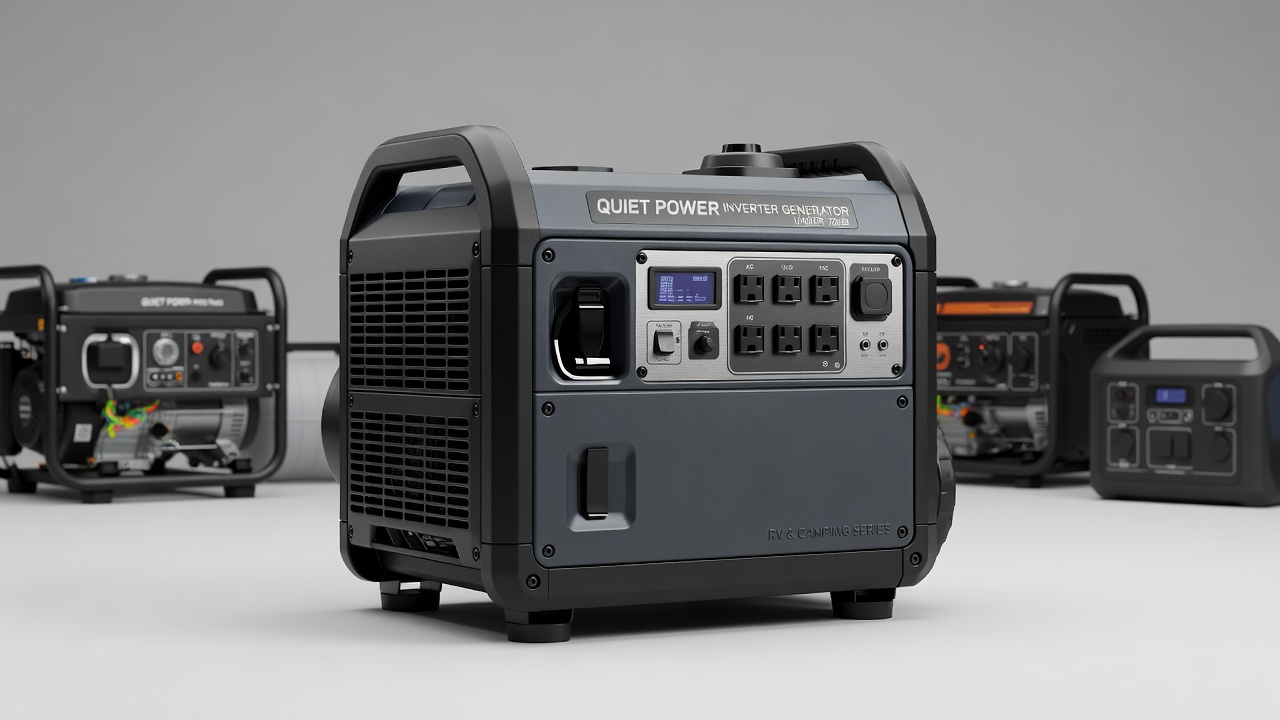
Honda EU2200i: The Gold Standard (48 dB)
The Honda EU2200i holds the title as the quietest gas-powered portable generator available in 2026. At quarter load, it measures 48 dB(A) at 23 feet - quieter than a typical refrigerator and well below the threshold of normal conversation.
Key specifications:
- Peak output: 2200W starting / 1800W running
- Noise level: 48 dB at quarter load, 57 dB at rated load
- Runtime: 8.1 hours at 25% load on a 0.95-gallon tank
- Engine: Honda GXR120 (121cc, 4-stroke OHV)
- Weight: 47.4 pounds
- THD: Less than 3% (safe for sensitive electronics)
The Honda GXR120 engine is legendary for durability. Many users report 2,000+ hours of runtime before requiring valve adjustments or spark plug replacement. The enclosed design features asymmetrical cooling fans and acoustic dampening foam that drops operating volume below the competition.
Who should buy it: Frequent campers who value ultra-quiet operation and long-term reliability. The Honda EU2200i costs 50% more than budget inverter models, but its resale value holds strong (used units sell for 70% of MSRP after 5 years), and warranty support remains responsive across the US and Canada.
Limitations: The 1800W rated output won't run a 13,500 BTU RV air conditioner on gasoline alone. For higher wattage needs, consider the Westinghouse iGen4500DF or parallel two EU2200i units using Honda's optional parallel cable.
Westinghouse iGen4500DF: Dual-Fuel Power (52 dB)
The Westinghouse iGen4500DF delivers 3700W of running power on gasoline or propane while maintaining a 52 dB noise rating at low load. Its double-insulated acoustic enclosure and low-tone mufflers keep it campground-legal while powering RV air conditioners, electric skillets, and multiple devices simultaneously.
Key specifications:
- Peak output: 4500W starting / 3700W running (gasoline)
- Noise level: 52 dB at low load
- Runtime: 18 hours at 25% load on 3.4-gallon tank (gasoline)
- Engine: Westinghouse 224cc OHV 4-stroke
- Fuel: Gasoline or propane (dual-fuel capable)
- Weight: 104.7 pounds
- THD: Less than 3%
- Start options: Electric push-button, remote key fob, recoil backup
Dual-fuel flexibility lets you run on 20-pound propane tanks when gasoline storage or availability becomes inconvenient. Propane output drops slightly to 4050W peak / 3330W running, but runtime on a standard 20-pound cylinder reaches 12 hours at 25% load.
Remote start via key fob lets you fire up the generator from inside your RV or tent without stepping outside in rain or cold. The electric push-button start works reliably down to 20°F ambient temperature when the battery maintains charge.
Who should buy it: RV owners who need to run a 13,500 BTU air conditioner plus lights, water pump, and electronics simultaneously. The 3700W rated output handles the surge draw from AC compressor startup without voltage sag. Weight (104.7 pounds) requires two people to lift into truck beds or RV storage compartments.
Limitations: The 52 dB rating applies at low load only. Under heavy sustained load (above 2500W), noise climbs to approximately 62 dB, which still meets most campground limits but loses the "whisper-quiet" advantage over cheaper models.
WEN 56225i: Budget Quiet Power (53 dB)
The WEN 56225i delivers 80% of the Honda EU2200i's performance at 60% of the price. Its 53 dB rating at quarter load meets campground noise ordinances, and its 79cc engine provides reliable power for lights, electronics, and small appliances.
Key specifications:
- Peak output: 2250W starting / 1800W running
- Noise level: 53 dB at quarter load, 57 dB at 75% load
- Runtime: 10.5 hours at 25% load on 1-gallon tank
- Engine: WEN 79cc 4-stroke OHV
- Weight: 39 pounds
- THD: Less than 1.2%
The WEN 56225i includes a fuel shutoff valve that drains the carburetor before storage, preventing gummed fuel deposits that plague generators left unused for months. This feature extends engine life and reduces the frequency of carburetor cleaning - a common maintenance headache with budget generators.
At 39 pounds, the WEN 56225i weighs 8 pounds less than the Honda EU2200i, making it easier to lift into truck beds or carry across campsites. The built-in handle design distributes weight evenly for single-person transport.
Who should buy it: Casual campers who need quiet, reliable power 10 to 20 days per year. The WEN 56225i won't survive 2,000 hours of continuous runtime like a Honda, but for weekend trips and seasonal use, it delivers excellent value. WEN's 2-year warranty covers defects, though warranty service requires shipping the unit to a service center rather than local dealer support.
Limitations: Build quality uses lighter plastic components compared to Honda or Yamaha metal construction. Reported failure modes after 200+ hours include recoil starter pawl breakage and carburetor float sticking. Preventive maintenance (fuel stabilizer, clean air filter, oil changes every 50 hours) keeps most units running reliably for 5+ years.
Yamaha EF2200iS: Reliable Mid-Tier Option (57 dB)
The Yamaha EF2200iS sits between Honda's premium pricing and WEN's budget positioning. At 57 dB at quarter load, it runs quieter than most conversations while delivering the same 1800W rated output as the Honda EU2200i.
Key specifications:
- Peak output: 2200W starting / 1800W running
- Noise level: 57 dB at quarter load (economy mode on), 65 dB at rated load
- Runtime: 10.5 hours at 25% load
- Engine: Yamaha 4-stroke OHV
- Weight: Approximately 55 pounds
- THD: Less than 2.5%
Yamaha's 4-stroke OHV engine shares design lineage with the company's marine outboard motors, benefiting from decades of vibration dampening and acoustic refinement. The engine idles down automatically under light load via the economy control system, dropping both fuel consumption and noise output.
Yamaha's US dealer network provides local warranty service and parts availability. Unlike WEN's ship-to-service-center model, you can drop a malfunctioning Yamaha at an authorized power equipment dealer for repair, often with loaner equipment available during service.
Who should buy it: Campers who want Honda-level reliability without Honda pricing. The Yamaha EF2200iS costs $150 to $200 less than the Honda EU2200i while delivering comparable performance and significantly better warranty support than budget models. Resale value holds at 60% of MSRP after 5 years.
Limitations: The 57 dB rating at quarter load is 9 dB louder than the Honda EU2200i, which translates to a noticeable perceived volume increase (dB scale is logarithmic). At rated load, the Yamaha climbs to 65 dB, putting it at the upper edge of campground compliance.
How to Choose the Right Quiet Generator
Match Wattage to Your Real Load
Calculate your total running wattage before buying. A typical tent camping setup (LED lights, phone chargers, small fan, electric cooler) runs on 200 to 400 watts. An RV with a 13,500 BTU air conditioner, refrigerator, water pump, and lights requires 2800 to 3200 running watts with a 4500W surge capacity for compressor startup.
The 1800W models (Honda EU2200i, Yamaha EF2200iS, WEN 56225i) handle tent camping, tailgating, and light RV use without air conditioning. For RV AC or higher simultaneous loads, step up to the Westinghouse iGen4500DF (3700W rated) or parallel two 2000W inverters using a manufacturer-approved parallel cable.
Budget vs Reliability Trade-Off
The Honda EU2200i costs $1,100 to $1,300 depending on retailer discounts. The WEN 56225i typically sells for $450 to $550. That $600+ price gap buys you:
- 9 dB quieter operation (48 dB vs 53 dB at quarter load)
- Superior build quality and longer engine lifespan (2,000+ hours vs 500-800 hours)
- Better resale value (70% vs 40% of MSRP after 5 years)
- Local dealer warranty service vs ship-to-service-center
If you camp 30+ days per year or need a generator for long-term power outage preparedness, the Honda justifies its premium. If you camp 10 days per year and need backup power for occasional tailgating or job site use, the WEN delivers excellent value.
Fuel Type: Gasoline vs Dual-Fuel
Gasoline-only models (Honda, Yamaha, WEN) cost less and weigh less than dual-fuel equivalents. Dual-fuel models like the Westinghouse iGen4500DF add 20 to 30 pounds of weight and $200 to $400 in cost but provide fuel flexibility when gasoline availability becomes limited or storing gasoline long-term poses a safety concern.
Propane doesn't degrade over time like gasoline, making it ideal for emergency preparedness generators stored for months between uses. Propane also burns cleaner, reducing carbon buildup and extending maintenance intervals.
Parallel Capability for Future Expansion
Most 2000W inverter generators support parallel operation, allowing you to connect two identical units with a manufacturer-specific cable to double your wattage output. Honda's EU2200i parallel kit (sold separately) combines two units for 3600W rated output while maintaining the 48 dB noise advantage of a single unit.
Buy a parallel-capable model even if you don't need the extra power today. Electrical needs grow over time. Starting with one 2000W unit and adding a second later costs less than buying a single 4000W generator and provides redundancy (if one unit fails, the other still delivers half your power).
RV Park Rules & Quiet Hours
Most RV parks and campgrounds permit generator operation only during designated hours, typically 8 AM to 8 PM. Overnight generator use is prohibited regardless of noise level in 85% of US campgrounds. The remaining 15% allow 24-hour operation only if your generator operates below 50 dB at 50 feet, which limits you to the Honda EU2200i running at quarter load or similar ultra-quiet inverter models.
Before booking a site, call ahead and ask three questions:
- What are your generator hours? Most parks enforce 8 AM to 8 PM, but some restrict it further to 8 AM to 12 PM and 4 PM to 8 PM (avoiding midday quiet time).
- What noise limit do you enforce? Some parks measure at 50 feet (60 dB federal standard), others at 23 feet (requires 52-55 dB generator).
- Are there generator-free zones? Many parks segregate tent campers into quiet zones where generators are banned entirely, reserving generator use for RV loops only.
State parks and federal campgrounds (National Park Service, BLM, Forest Service) universally enforce the 60 dB at 50 feet standard during permitted hours. Private campgrounds set their own rules - KOA franchises typically follow the 60 dB standard, while Thousand Trails and Passport America networks often tighten it to 60 dB at 23 feet.
Violation consequences range from warnings (first offense) to immediate ejection without refund (repeat offenders). Rangers and campground hosts carry handheld decibel meters and conduct spot checks during permitted hours.
Frequently Asked Questions
What noise level is considered quiet for a portable generator?
A quiet generator operates between 48 and 60 decibels (dB) at quarter load. For context, 60 dB is roughly the volume of a normal conversation, and 48 dB is quieter than most refrigerators. Most RV parks and campgrounds enforce a 60 dB limit measured at 50 feet from the source. Traditional open-frame generators typically run at 70 to 76 dB under load, which violates most campground noise ordinances.
Can I run a quiet generator overnight at an RV park?
Most RV parks permit generator use only during designated hours, typically 8 AM to 8 PM. Overnight operation is generally prohibited regardless of noise level. A few parks allow 24-hour generator use if the unit operates below 50 dB at 50 feet, which restricts you to the Honda EU2200i (48 dB at quarter load) or similar ultra-quiet inverter models. Always check campground rules before arrival.
Is the Honda EU2200i worth the premium over budget inverter generators?
Yes, if noise and reliability are your top priorities. The Honda EU2200i runs at 48 dB at quarter load, quieter than any competing model. Its Honda GXR120 engine is legendary for durability, often running 2,000+ hours before requiring maintenance. Budget models like the WEN 56225i (53 dB, $450) offer 80% of the performance at 60% of the price, but the Honda's build quality, warranty support, and resale value justify the cost for frequent campers and full-time RVers.
How far away should I place my generator from my campsite?
Position your generator at least 20 feet from occupied tents or RVs to reduce both noise and carbon monoxide exposure. At 20 feet, a 52 dB generator drops to approximately 46 dB perceived volume due to distance attenuation. Never run a generator inside a tent, RV, garage, or enclosed space. Exhaust must vent into open air. If your campsite layout forces closer placement, consider a quieter model (Honda EU2200i at 48 dB) or run only during daytime hours when neighbors are less noise-sensitive.
Do dual-fuel generators run quieter on propane or gasoline?
Noise levels remain nearly identical between gasoline and propane operation on the same dual-fuel generator. The Westinghouse iGen4500DF runs at 52 dB on both fuels at quarter load. Propane does produce slightly cleaner combustion (less engine knock), but the acoustic enclosure and muffler design determine overall noise, not fuel type. Choose your fuel based on availability, storage preference, and runtime needs, not noise reduction.
The 2026 Verdict: Best Quiet Generator for Your Needs
Best overall quiet generator: Honda EU2200i - The 48 dB rating beats every competing model. If budget allows, this is the gold standard for tent camping and strict RV parks.
Best value quiet generator: WEN 56225i - 53 dB meets campground noise limits at 60% of Honda's price. Ideal for casual campers who need quiet power 10 to 20 days per year.
Best for RV air conditioning: Westinghouse iGen4500DF - 3700W rated output handles 13,500 BTU AC startup while maintaining 52 dB noise at low load. Dual-fuel flexibility and remote start add convenience.
Best Honda alternative: Yamaha EF2200iS - Yamaha's dealer network and build quality rival Honda at a lower price point. 57 dB is louder than the EU2200i but still campground-compliant.
Every generator reviewed here operates below 60 dB at quarter load, meeting federal campground noise standards. Your choice depends on budget, power requirements, and how often you camp. Frequent campers justify the Honda premium. Weekend warriors find excellent value in WEN. RV owners running air conditioning need the Westinghouse's higher wattage.
For related generator buying guides, see Best Tri-Fuel Generator 2026, Best 5000W RV Generator Under $2000, and Honda EU2200i vs Yamaha EF2200iS Camping Comparison.
Affiliate Disclosure: GeneratorIntel participates in the Amazon Services LLC Associates Program, an affiliate advertising program designed to provide a means for sites to earn commissions by linking to Amazon.com. We earn commissions from qualifying purchases made through our Amazon links at no additional cost to you. These commissions support our research, testing, and content creation. We recommend products based on specifications, performance, and value, not commission rates.