Published: October 6, 2026 | Last Updated: October 6, 2026
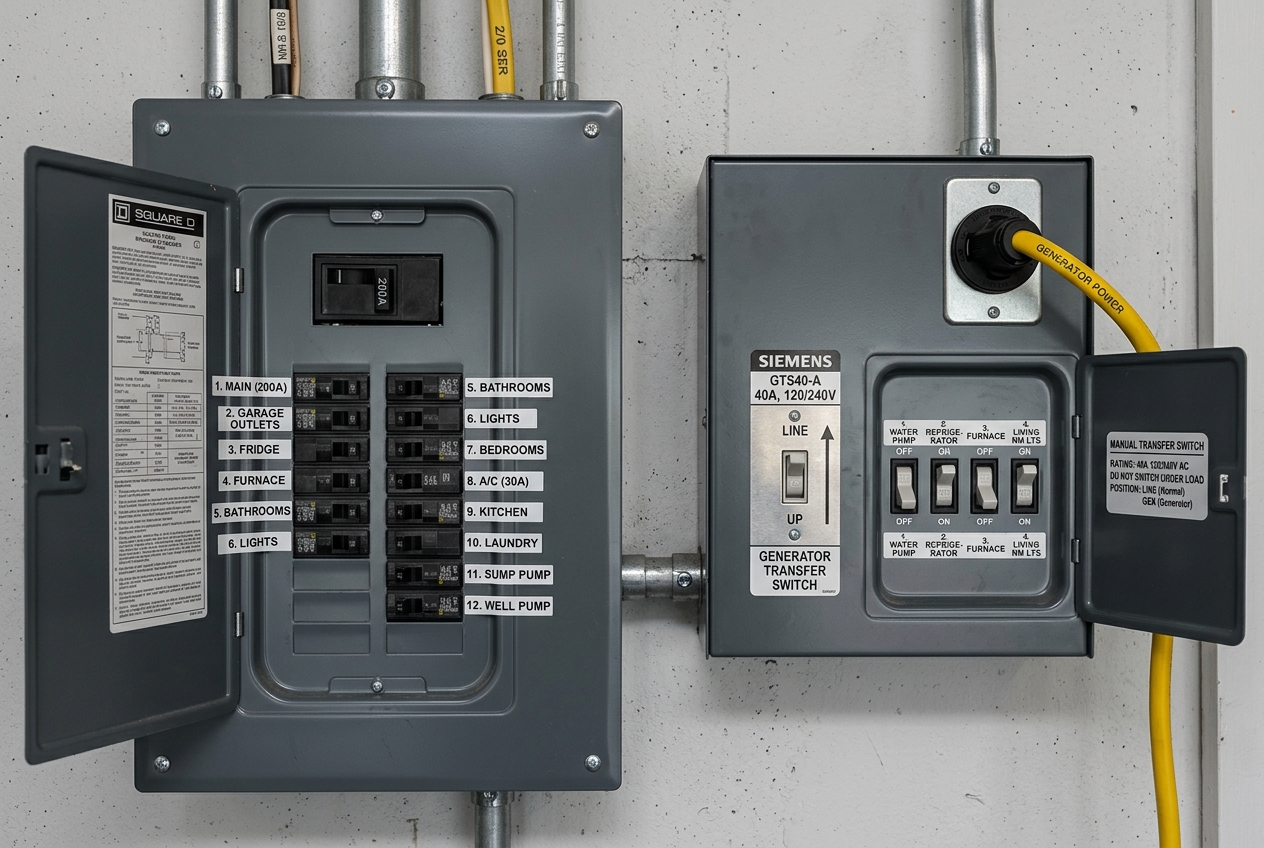
Connecting a portable generator to your home safely requires either a transfer switch or an interlock kit. There is no legal third option - plugging a generator into a wall outlet to backfeed your panel is illegal under the National Electrical Code, can electrocute utility lineworkers, and voids your homeowner's insurance. What separates transfer switches from interlock kits is not safety (both are code-compliant when properly installed) but cost, circuit access, and how much load management you want to handle manually during an outage. This comparison covers both options in full: what each does, what it costs installed, who should use which, and the products that pair well with each setup.
Affiliate Disclosure: GeneratorIntel participates in the Amazon Services LLC Associates Program. We earn commissions from qualifying purchases through our Amazon links at no extra cost to you. We recommend products based on specifications, performance, and value, not commission rates.
Quick Picks: Transfer Switch vs Interlock Kit at a Glance
| Option | Hardware Cost | Installed Total | Circuits Available | Code Acceptance | Best For |
|---|---|---|---|---|---|
| Interlock Kit | $50-$150 | $300-$600 | All panel circuits | Most jurisdictions (verify locally) | Budget-conscious, whole-panel access, portable generators |
| Manual Transfer Switch | $300-$600 | $700-$1,400 | 6-10 pre-selected | All jurisdictions (UL-listed) | Simplicity during outages, guaranteed code acceptance, upgrade path to standby |
| Automatic Transfer Switch | $500-$2,000 | $2,000-$5,000 | Whole home | Required for standby generators | Standby generators - Generac, Kohler, Westinghouse |
Bottom line: For most homeowners with a portable generator and a tight budget, an interlock kit installed by a licensed electrician is the practical choice - it costs $300-$600 all-in and gives access to every circuit in your panel. A manual transfer switch costs $700-$1,400 but is simpler to operate during an outage and is guaranteed to satisfy any local inspector. Standby generators require an automatic transfer switch - interlock kits and manual switches do not apply. See top-rated portable generators for either setup: Westinghouse WGen9500DFc or Westinghouse WGen9500DF.
What a Generator Interlock Kit Actually Does
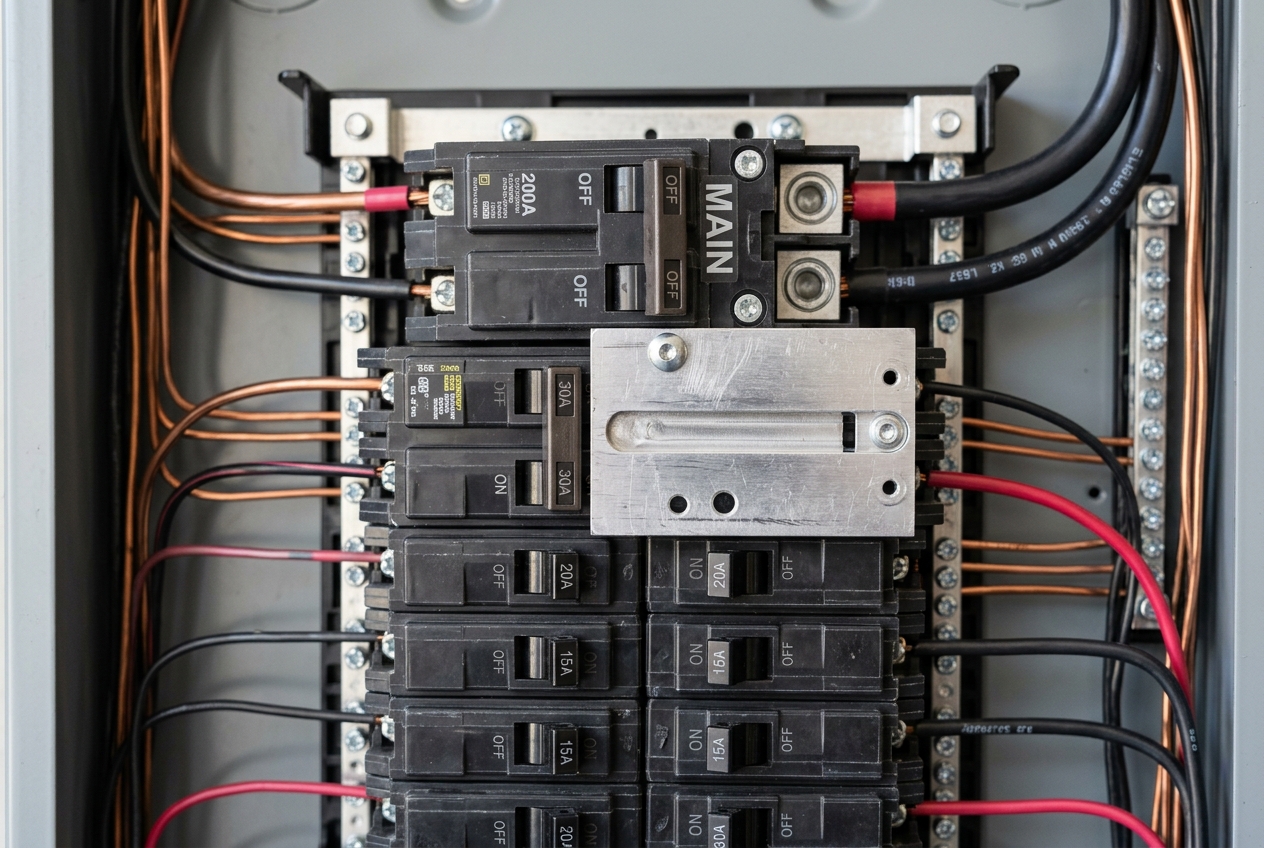
An interlock kit is a sliding metal plate that mounts to the outside of your existing main breaker panel. The plate is shaped so that the main utility breaker and a dedicated generator breaker cannot both be in the ON position simultaneously - the mechanical slide physically blocks one when the other is active.
The installation sequence your electrician performs:
- Installs a dedicated two-pole breaker (typically 30A or 50A) in your existing panel for the generator input
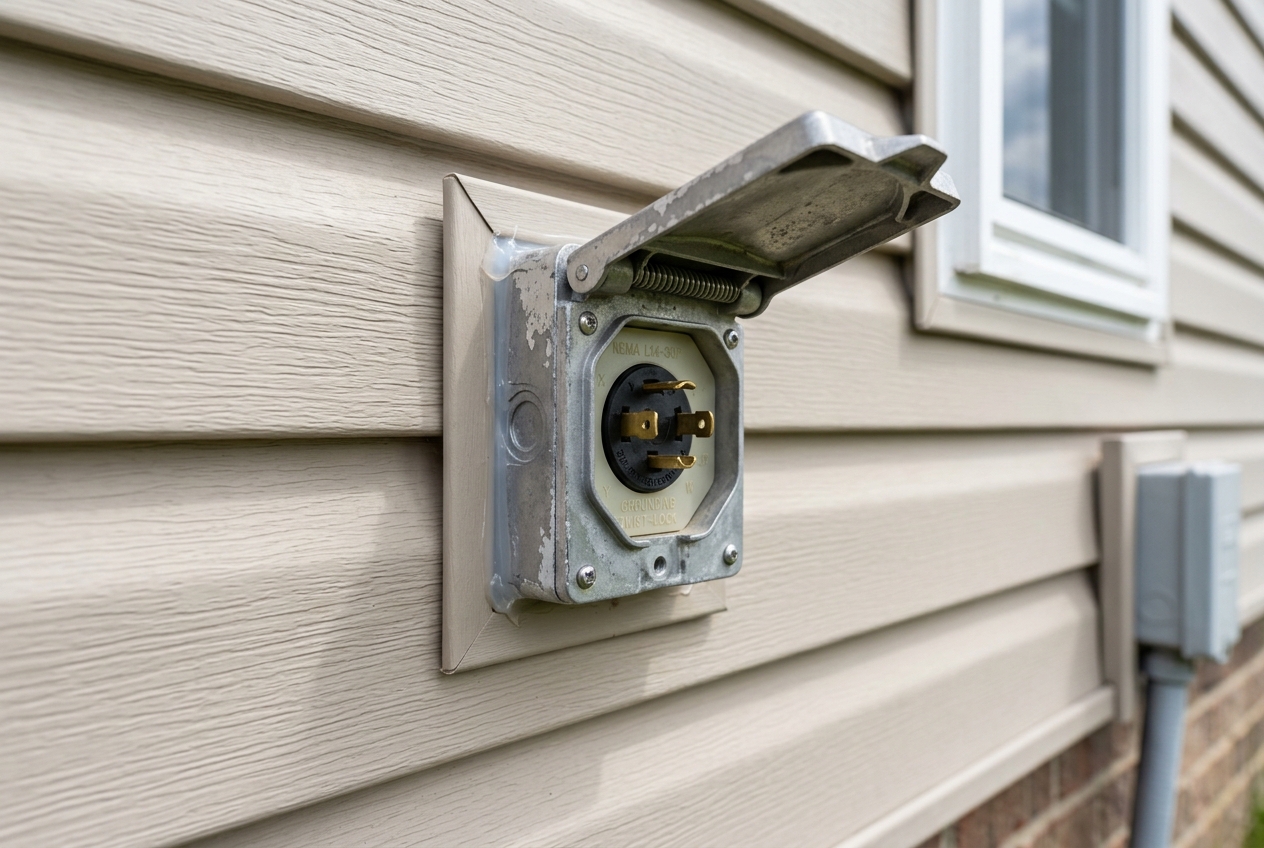
- Runs conduit and wire from that breaker to a NEMA L14-30 or L14-50 inlet box mounted on your home's exterior
- Bolts the interlock plate to the panel cover over both the main breaker and the new generator breaker
- Installs the NEC 702.7(C) required warning label at the exterior inlet
When you need generator power during an outage, the manual sequence is:
- Start your generator outside (20+ feet from the house per CO safety rules)
- Go to your main panel and turn off all individual circuit breakers
- Flip the main utility breaker OFF
- Slide the interlock plate to expose the generator breaker position
- Flip the generator breaker ON
- Turn on individual circuits one at a time, monitoring your generator's load meter to stay within capacity
The big advantage: every circuit in your panel is available. You decide what runs based on what your generator can handle. The limitation: you must manage the load manually and the process takes 2-4 minutes from the time power fails to the time your selected circuits are live.
Critical compatibility check: Interlock kits are panel-specific. A Square D kit does not fit a Siemens panel. You must purchase the kit designed for your exact panel manufacturer and main breaker frame size. Confirm your panel brand and model before ordering the hardware.
What a Manual Transfer Switch Actually Does
A manual transfer switch is a small sub-panel - typically 6-10 circuits - installed beside your main panel. Your electrician moves selected branch circuits from the main panel into the transfer switch during installation. Those circuits get three-position toggles: LINE (utility), OFF, and GEN (generator).
You choose which circuits go into the transfer switch at installation time. Most homeowners select the same critical loads: furnace or heat pump, refrigerator, well pump, one or two lighting circuits, and a general-purpose outlet circuit. Once wired, the process during an outage is straightforward:
- Start your generator outside
- Connect the generator cord to the inlet box
- Flip the transfer switch breakers from LINE to GEN for the circuits you want to run
The sub-panel's labeled breakers make this intuitive even for household members who are not electrically comfortable. Better models include wattmeters so you can see your load in real time without watching the generator's external gauges.
The limitation: only the pre-selected circuits are available. If you didn't wire your home office circuit into the transfer switch during installation, it won't run on generator power - period. This requires planning ahead at installation time. It also means that if your priorities change (new chest freezer, new medical equipment), you may need to have the electrician rewire the transfer switch.
Cost Comparison: The Real Numbers
Hardware prices are easy to find online. What homeowners routinely underestimate is the installed cost including labor, permits, and the inlet box. Here are realistic 2026 figures based on multiple sources:
| Cost Component | Interlock Kit | Manual Transfer Switch | Automatic Transfer Switch |
|---|---|---|---|
| Hardware | $50-$150 | $300-$600 | $500-$2,000 |
| Generator inlet box | $55-$105 | Included in most kits | N/A (standby has fixed wiring) |
| New breaker (if needed) | $15-$40 | Included in sub-panel | Included |
| Electrician labor | $150-$300 | $400-$800 | $500-$1,500 |
| Permit fees (est.) | $50-$150 | $75-$200 | $100-$300 |
| Total Installed | $320-$745 | $775-$1,600 | $1,100-$3,800+ |
Regional variation matters here. Labor rates in rural Midwest markets run 30-40% lower than coastal metros. If you're in the Northeast or Pacific Coast, add 25-35% to these estimates. Get two or three quotes from licensed electricians in your area before committing.
One cost comparison note: the transfer switch hardware gap ($50-$150 vs. $300-$600) is real, but the labor gap is larger and often overlooked. Moving 6-10 circuits into a new sub-panel is a 4-6 hour job. Installing an interlock plate and inlet box typically takes 1.5-3 hours. That labor delta alone can be $200-$400.
Safety: Are Both Options Equally Safe?
Yes - with a critical qualifier. Both interlock kits and manual transfer switches are mechanically safe methods for connecting a portable generator to your home, provided they are installed by a licensed electrician with a permit and inspected by a licensed electrical inspector.
The safety function they both perform is identical: preventing simultaneous connection of your generator and the utility grid. Feeding generator power backward through your meter into the utility lines while lineworkers are restoring power to your neighborhood can cause fatal electrocution. Both devices make this physically impossible.
Where the safety question gets nuanced:
- Interlock kit risk: The interlock prevents backfeeding, but it does not prevent you from overloading the generator by turning on too many circuits. With a manual transfer switch, you're limited to the pre-selected critical loads. With an interlock kit, you have access to every 240V and 120V circuit in the panel - your electric range, electric dryer, air compressor, electric water heater. Overloading a generator causes voltage instability that can damage connected electronics. Managing load manually is an operator skill requirement, not a flaw in the interlock design, but it matters if household members less familiar with electrical loads will be managing the generator during an outage.
- Transfer switch risk: Essentially none beyond normal electrician-installation quality. The sub-panel with labeled breakers makes overloading very difficult because the pre-selected loads are your critical loads only.
Carbon monoxide - neither device eliminates this risk. CO poisoning from portable generators running in attached garages, basements, or under covered porches kills dozens of Americans every year. Run any portable generator outdoors, at least 20 feet from the house with exhaust pointed away from windows and vents, regardless of whether you're using an interlock kit or a transfer switch. If your generator has a built-in CO shutoff sensor (like the Westinghouse WGen9500DFc), that reduces but does not eliminate risk for people and pets near the exhaust stream outside.
Code Compliance: NEC, Local AHJs, and the Permit Question
The National Electrical Code (NEC) Article 702 governs optional standby systems - which includes portable generator connections. Article 702.5 requires transfer equipment that prevents two power sources from connecting simultaneously. Both interlock kits and transfer switches satisfy this requirement when properly installed.
The complication: NEC is a model code. Local jurisdictions adopt it with amendments, and the Authority Having Jurisdiction (AHJ) - your local building department and electrical inspector - has final say on what constitutes acceptable transfer equipment in your area.
The practical difference between interlock kits and transfer switches in this context:
- UL-listed transfer switches are certified as transfer equipment by an independent testing laboratory. Every inspector in every jurisdiction accepts them without question.
- Interlock kits may or may not carry a listing as transfer equipment depending on the manufacturer. Panel manufacturer's own interlock kits (Square D's kit for Square D panels, Siemens' kit for Siemens panels) are covered under that panel's UL 67 listing. Third-party kits may not be. Some inspectors and some jurisdictions require a listed transfer switch regardless - they will reject an interlock kit, full stop.
Before purchasing anything, make one phone call. Call your local building department and ask: "Does my jurisdiction allow a residential generator interlock kit on a main panel, or do you require a listed transfer switch?" This is a routine question they handle regularly. One call eliminates the risk of buying the wrong product.
If your jurisdiction rejects interlock kits, you need a manual transfer switch. End of analysis. If they accept interlock kits, you have a genuine choice based on budget and operating preference.
Which Portable Generator Works with Each Option
Both interlock kits and manual transfer switches connect to your generator via a generator inlet box - typically a NEMA L14-30 (30 amp, 240V, for generators up to ~7,500W) or L14-50 (50 amp, 240V, for generators 7,500W+) outdoor outlet mounted on your home's exterior. Your generator connects via a matching cord.
Generator sizing rules for the two methods differ slightly:
- With an interlock kit: Size your generator for the total load you plan to run simultaneously. Because you have access to your full panel, the risk of accidentally overloading is real. A generator with built-in load meters and CO safety shutoff helps manage this. The Westinghouse WGen9500DFc (9,500 running watts, CO alert, dual fuel) pairs well here - enough headroom for central HVAC, a well pump, and a full refrigerator simultaneously, with a CO safety shutoff as a backup protection layer.
- With a manual transfer switch: Size your generator for the sum of the pre-selected critical circuits. Because you can't accidentally feed your 240V dryer circuit through the transfer switch sub-panel, you can use a slightly smaller generator. The Westinghouse WGen9500DF (9,500 running watts, dual fuel) covers most critical-load transfer switch configurations comfortably.
If you are considering a standby generator rather than a portable - Generac, Kohler, or Westinghouse whole-home units - neither the interlock kit nor the manual transfer switch applies. Standby generators require an automatic transfer switch, which is typically included with the unit or sold as a package. See our Generac vs Kohler standby generator comparison for that decision.
DIY vs Electrician: Who Does the Installation
Both options require a licensed electrician. This is not a gray area.
Installing either device involves opening your main electrical panel where live bus bars carry full utility voltage - typically 200 amps at 240 volts. The main breaker does not de-energize the incoming service lines from the utility. An electrician working in your panel is working near live conductors that cannot be safely de-energized without the utility company pulling the meter. This is not a weekend project.
Beyond safety, the permit requirement makes DIY installation impractical in most jurisdictions. If an unpermitted electrical installation contributes to a fire, electrical injury, or property damage, your homeowner's insurance may deny the claim. An unpermitted generator connection is also a liability in a real estate transaction - a future buyer's inspector will find it.
Budget for $150-$300 for interlock kit installation labor and $400-$800 for transfer switch installation labor. Get quotes from two or three licensed electricians - rates vary significantly by market and workload.
Who Should Choose an Interlock Kit
An interlock kit is the right choice if:
- Budget is the primary constraint and you want to stay under $600 all-in
- Your local AHJ accepts interlock kits (verify this with one phone call first)
- You want access to your full panel during outages - well pump, medical equipment, 240V loads
- You are comfortable manually managing generator load (monitoring wattage, turning circuits on one at a time)
- Your panel manufacturer makes a compatible interlock kit (Square D, Eaton, Siemens, Cutler-Hammer, Murray, and others have OEM kits)
- You are connecting a portable generator, not a standby unit
Who Should Choose a Manual Transfer Switch
A manual transfer switch is the right choice if:
- You want guaranteed code acceptance in any jurisdiction without the local-AHJ verification step
- Simplicity during a stressful outage is the priority - flip a few labeled switches rather than managing individual panel circuits
- You plan to eventually upgrade to a standby generator; a transfer switch sub-panel can be adapted more easily than an interlock setup
- Household members who will operate the system during your absence are not comfortable managing panel breakers
- Your main panel does not have a compatible manufacturer-specific interlock kit available
- Your critical loads are already well-defined (furnace, fridge, well pump, few lights) and you don't need whole-panel flexibility
Frequently Asked Questions
Is a generator interlock kit legal and code-compliant?
Yes, when properly installed by a licensed electrician with a permit. NEC Article 702.5 requires transfer equipment that prevents two power sources from connecting simultaneously - an interlock kit satisfies this mechanically. However, some local jurisdictions require a UL-listed transfer switch and will reject interlock kits. Call your local building department before purchasing and ask specifically whether interlock kits are accepted in your jurisdiction.
What does a generator interlock kit cost installed?
An interlock kit costs $50-$150 for the hardware plus $150-$300 for licensed electrician labor, plus $55-$105 for the exterior generator inlet box. Total installed cost runs $300-$600 for most residential installs, not counting permit fees. This makes it the least expensive legal method for connecting a portable generator to your home's panel.
What does a manual transfer switch cost installed?
A manual transfer switch (6-10 circuit sub-panel) costs $300-$600 for the hardware kit, which typically includes the inlet box and generator cord, plus $400-$800 for installation labor. Total installed cost runs $700-$1,400 depending on the number of circuits, wire run distance, and local labor rates. An automatic transfer switch for a standby generator runs $2,000-$5,000 installed.
Can I use an interlock kit with a standby generator?
No. Interlock kits are for portable generators only. Whole-home standby generators (Generac, Kohler, Westinghouse) start and switch automatically when utility power fails - there is no manual step where you would engage an interlock. Standby generators require an automatic transfer switch (ATS), which is typically sold with or alongside the generator unit.
Which gives access to more circuits - transfer switch or interlock kit?
An interlock kit gives access to every circuit in your existing panel - you manually turn on only what your generator can handle. A manual transfer switch gives access only to the pre-selected circuits wired into the sub-panel at installation, typically 6-10 circuits chosen in advance. The interlock kit wins on circuit flexibility; the transfer switch wins on simplicity because you're only managing pre-labeled critical loads.
Is backfeeding a generator through a dryer outlet safe?
No. Backfeeding is illegal under the National Electrical Code and can electrocute utility lineworkers restoring power to your neighborhood. It also risks destroying your generator and your home's wiring when utility power returns. A double-ended "suicide cord" or "male-to-male" cord plugged into a dryer outlet is not a substitute for a proper transfer device. Both interlock kits and transfer switches exist specifically to prevent this.
Do I need a permit for a generator interlock kit or transfer switch?
Yes, in most jurisdictions. Connecting a generator to your home's electrical panel requires an electrical permit, licensed electrician installation, and inspection. Skipping the permit creates insurance liability risk - if an unpermitted installation contributes to a fire or injury, your homeowner's insurance may deny the claim. It can also create problems at future home sale when buyers' inspectors find unpermitted electrical work.
The 2026 Verdict
For most homeowners connecting a portable generator to their home, the interlock kit wins on cost. At $300-$600 installed vs. $700-$1,400 for a manual transfer switch, the savings are real and the safety function is identical. The interlock also wins on circuit flexibility - you can run any load in your panel that your generator can support, without being locked into circuits you chose years ago.
The manual transfer switch wins on simplicity and guaranteed code acceptance. If your local jurisdiction rejects interlock kits, the switch is your only option. And if you have household members who will need to manage generator power during an extended outage in your absence, pre-labeled critical-circuit breakers are much harder to mismanage than a live panel with 20+ breakers and no labels.
Before buying anything, make two decisions: first, verify with your local building department that interlock kits are accepted in your jurisdiction. Second, decide whether you want whole-panel access or pre-selected critical-circuit simplicity. Those two answers determine the right path.
For the generator itself, the Westinghouse WGen9500DFc works well with either connection method and adds a built-in CO alert shutoff as a safety layer. For a lower price point with similar capacity, the Westinghouse WGen9500DF covers the same use case without the CO sensor. For standby generator options that require an automatic transfer switch, see our Generac vs Kohler comparison and our whole-house generator installation cost guide.
Affiliate Disclosure: GeneratorIntel participates in the Amazon Services LLC Associates Program, an affiliate advertising program designed to provide a means for sites to earn commissions by linking to Amazon.com. We earn commissions from qualifying purchases made through our Amazon links at no additional cost to you. As an Amazon Associate I earn from qualifying purchases. These commissions support our research, testing, and content creation. We recommend products based on specifications, performance, and value, not commission rates.
Photos provided by Pexels.